
1927 - The First Outside Broadcast from Galway by Peter Rabbitt
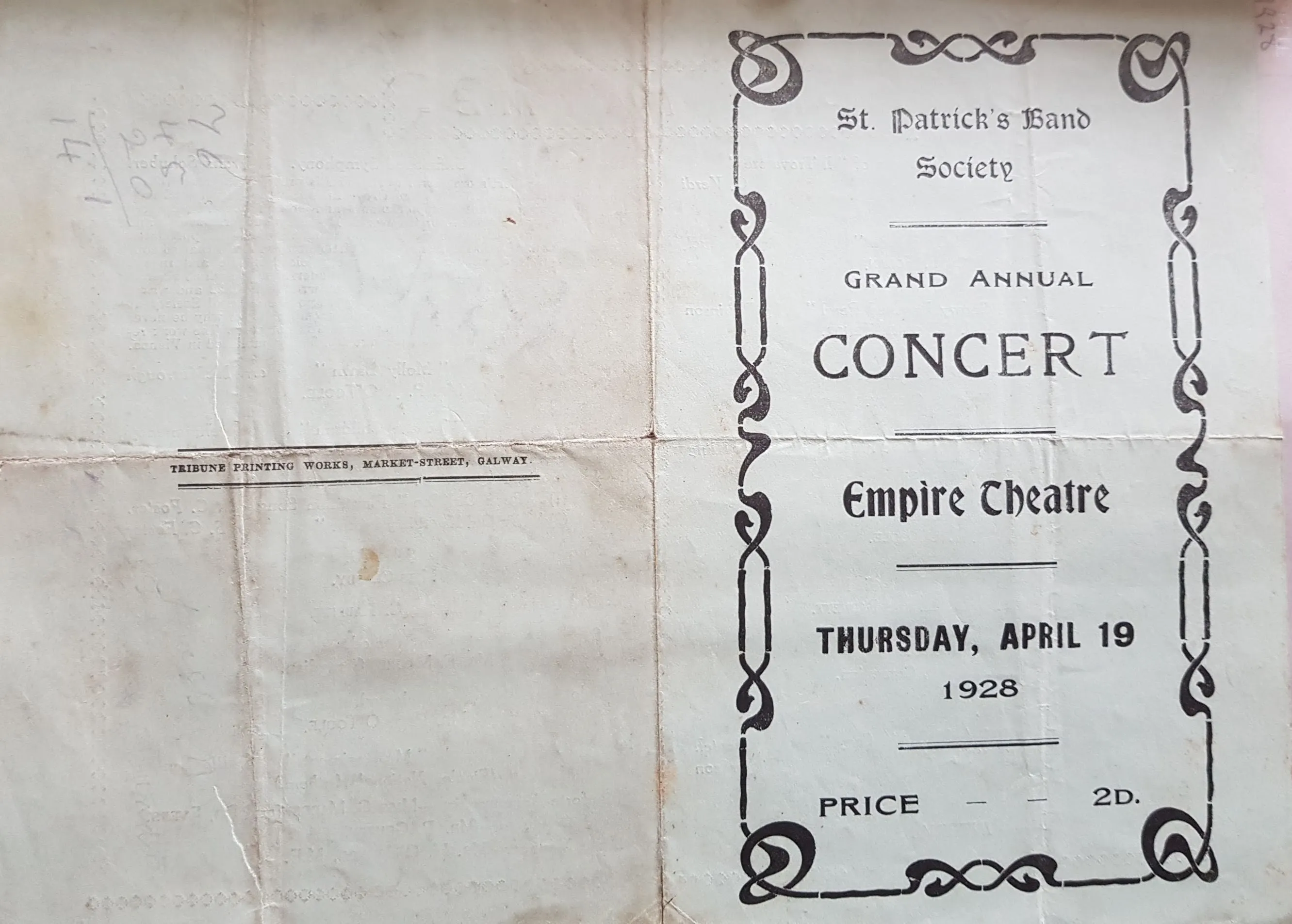
Thousands of people, all over Ireland, England and even on the Continent, gathered around wireless sets in November 1927 to listen to the first outside broadcast on the radio from Galway. On November 17, 1927 a concert, in aid of the National Relief Fund for dependants of the Cleggan Disaster, was broadcast from the Empire Theatre in the centre of Galway.
At 9 p.m. St. Patrick's Band playing John Philip Sousa's march 'Stars and Stripes' was heard loud and clear on the radio. Mr. Paddy Griffin, Bandmaster, was conductor of the band for that historic occasion. The second portion of concert was broadcast on the Radio Station, 2RN, that had been set up in Dublin and which first went on air in 1926. The Galway concert, which subsequently was deemed to have been a great success, had been arranged at short notice by Miss May Fogarty, St. Patrick's Band and the Empire Theatre Orchestra. It was held under the auspices of Galway Chamber of Commerce who in turn persuaded the new Radio Station, 2RN to broadcast it live from Galway. It seemed appropriate that with emigration so rampant at the time, and with many of the Gaeltacht and West of Ireland peoples living in Dublin and other areas in Ireland, as well as London and England, that the concert in aid of the Appeal Fund would be broadcast. Exiles and sympathisers would be able to participate in the event of November 17 by listening to the concert itself and to the appeals on behalf of the dependants given by T.W.J. Kenny of the Galway Chamber of Commerce and Professor Liam O'Briain (in Irish) of University College Galway.
The scale of the Cleggan Disaster had struck a chord with people at home and abroad and everyone wanted to do something to help. On the evening of October 28, 1927 fishermen all along the West Coast of Ireland went fishing on the calm Atlantic Ocean. Some people heard a storm warning on their wireless sets but in most cases it was too late to warn the fishermen who had already gone to sea off the Cleggan coast. A sudden storm erupted and swamped the fishing vessels comprising mainly of currachs and pucans. 44 men lost their lives on that fateful night. Men who lived on Inishbofin and Rossadilisk in Co. Galway and Inniskea and Lacken in Co. Mayo were lost. It was estimated, at a later date, that there were about 164 direct relatives left destitute by the loss of the families' breadwinners. The sad events were reported in newspapers far and wide and on the radio. Donations from people all over Ireland and abroad started to pour into the national and local newspapers that had immediately set up appeal funds. As a result of the national outpouring of grief a National Appeal Fund for the dependants of the fishermen was set up by President WT. Cosgrave and a board established to administer the funds included the editors of newspapers and clergy along the West coast including the Archbishop of Tuam.
The disaster galvanised the music confraternity into action in Galway and one of the leading musicians at the time, May Fogarty, set about arranging a concert and all proceeds raised by the concert were to be send to the National Appeal Fund. The concert itself caught the imagination of people in Galway who wanted to play their part in some way to help the grief stricken dependants. Artistes included vocalists Mrs. J.V.Joyce, Dublin; the Rev. E.H. Jackson of Westport; Dr. Michael Davitt of Galway; Mr P. Tiernan of Galway; violinist Miss May Fogerty and pianist Dr. Louis Evers, as well as St. Patrick's Band and the Empire Theatre Orchestra. A combined orchestra of St. Patrick's Band brass players and the Empire Orchestra supported the soloists. T.W. J Kenny of the Galway Chamber of Commerce became involved and when the line-up for the concert was known it was thought that it would make a fine broadcast. The Director of 2RN, Mr. Chandillon, readily agreed to the suggestion and all of the stops were pulled out to make a success of the venture. It was decided to defer regular programmes on 2RN and broadcast the second portion of the Galway concert from 9 p.m. to 10.30p.m.
Post office linesmen were sent into action to prepare for the broadcast as the concert was to be relayed from a microphone on the stage of the Empire Theatre in Galway over the telephone line to Dublin. In preparation for the event the artistes and bands held special rehearsals. The local papers, which continually highlighted the Cleggan Disaster, supported the Concert and the live broadcast and kept the public informed about the efforts going into the venture and reported details on the arrangements. Support for the Concert, and the Appeal, by Galwegians was also encouraged.
The accounts of the arrangements from the local newspapers make interesting reading and the Connacht Sentinal had a leading article from the editor on it.(details below)
The broadcast as well as the concert itself, which included an appeal from T.W.J. Kenny and Professor O'Briain speaking in Irish was a complete success. The reception, on the whole was good. Both the artists and the audience felt that they were participating in a major new venture in Galway and the Connacht Tribune of November 19, 1927 gives an excellent account (detailed below) of the historic event that gives a flavour of the performances and outlines the sense of occasion.
The Concert and broadcast were a complete success and there was complete rejoicing at the achievement of the musicians and other participants as well as the 'behind the scenes' workers. Letters and telephone calls congratulating the organisers and artistes poured in from all over Ireland and England and many were published in the press.
Again an account of the concert and a transcription of the appeal from T.W.J. Kenny and Professor O'Briain, as Gaeilge, were published and one can gather the momentous occasion from the article in the Connacht Tribune November 19, 1927:
Proceeds from the Concert itself realised £28.6s.1d, and a Matinee organised by the Theatre Proprietress, Mrs McNally, amounted to £26.14s.2d. By the end of December 1927 over £30,000 had been collected by the National Appeal Fund, an enormous sum for that time.
Tragedies continued on the sea however when the relatives of two Aran Islanders were added to the Appeal list after they died crossing from Carraroe to Aran after a days fishing that December. The account of their deaths at their inquest published on January 3, 1928 makes harrowing reading. The radio became an important aid to the fishing communities as e.g. warnings of bad weather undoubtedly saved lives.
The success of that first broadcast from the Empire Theatre meant that there were regular outside broadcasts from Galway e.g. a successful relay of the Galway Conradh na Gaeilge Concert on St. Patrick's Night 1928 was broadcast on the radio, 2RN.
Notice Published announcing Concert
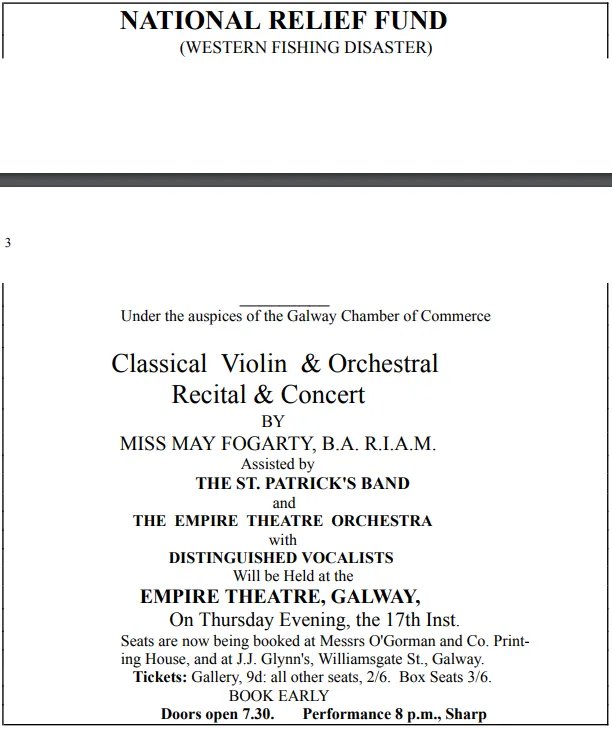
Published Reports on build-up to the Historic Event
The Connacht Sentinal November 15, 1927
' the first broadcast from Galway through the Dublin Station 2RN, will take place on Thursday night next, when the Concert and Violin Recital to be held at the Empire Theatre in aid of the National Relief fund will be relayed from the stage by overland telephone wire to Dublin, and from there sent out into the ether.' '.... The entire second portion of the programme is to be relayed.' ' Already telephone linesmen have arrived in Galway to make the necessary mechanical preparations, and the line will be carefully watched at vital points along its 130 mile of length from the stage...to 2RN's Station at the Phoenix Park, where amplification and broadcasting will take place.' The fact that the concert will be broadcast to all who are able to pick it up throughout Ireland and the British Isles, as well as the Continent gives it added interest for local folks; and a considerable attendance and an enthusiastic house is anticipated.' 'programme has been admirably chosen, and includes such well known vocalists as Mrs. J.V.Joyce, Dublin; the rev. E.H. Jackson of Westport; Dr. Michael Davitt of Galway; Mr P. Tiernan of Galway; such brilliant instrumentalists as Miss May Fogerty and Dr. Louis Evers, and a combined orchestra of St. Patricks' and the Empire Bands.
Editorial
The Connacht Sentinal of Galway, Tuesday evening November 15, 1927 had a leading article which detailed the upcoming historical events in Galway at that time:
'Thursday's Night's Broadcast Concert: The Concert and Violin Concert to be given at the Empire Theatre, Galway, on Thursday evening is of much more then ordinary interest for everyone whose sympathies or whose hopes lie in the West. The object for which it is being held, the National Relief Fund for the relatives of the Western fishermen lost in the recent terrible disasters, should of itself be sufficient to ensure for it the widest and most generous possible measure of public support. In order that everyone possible may have a share in helping the National Fund, prices to suit every purse are being charged for admission. They vary from 3s 6d to the modest 9d. Of the quality of the concert there need not be the smallest doubt. The programme has been selected with care and discrimination, and contains both popular and classical items. The St. Patrick's Band of simple working men have already proved themselves a musical combination of which no community need be ashamed. But the real interest in the concert itself will lie in the fact that for the first time it will inaugurate a broadcast through the Dublin Station(2RN) of a programme relayed by telephone from the Capital of the Gaeltacht.'
'The especial thanks of Connacht are due to the Director and staff of 2RN for their prompt and ready response to the call of the Galway Chamber of Commerce to have a portion of the programme from 9 till 10.30 broadcast. Although 2RN's own programme had been arranged and contracts signed, Mr. Chandillon, the Director, notwithstanding the considerable difficulties that lay in his path readily assented to Galway's request. This is a very practical earnest of sympathy with the West, and we hope it will bear fruit in the future. It is now the interest and duty of the people of Galway and the surrounding districts by their purchase of tickets and attendance at the concert in considerable numbers to show that they, too, have a live interest in the redemption of the Gaeltacht that lies so near to them on the West coast.'
Historic Event
Connacht Tribune ,Saturday, November 19, 1927
VIOLIN AND Concert: Broadcast from Galway: Successful Performance
'For the first time since the introduction of wireless broadcasting there was a relay from Galway to Dublin and Cork last night, and the concert and appeals on behalf of the Western relief fund were broadcast to all the listeners within range in this country and outside it. The experience was a novel one, not only for the artistes that took part in the concert, but to the audience in the Empire Theatre, where it was held. The broadcast took place of the second portion of the performance, between 9 p.m. and 10.30 p.m., and for that period the audience felt that they were participators in a drama where the artistes were merely their representatives and that their success would rebound to the credit of Galway. What the feeling of the artistes who had to face the microphone were, we do not know, but the audience felt that they themselves were in a privileged position and that a successful broadcast was of paramount consideration. Thanks to everyone concerned the concert was in every way a satisfactory performance, and the broadcast was distinctly heard in Dublin and all over the South of Ireland. Listeners on receiving sets in Galway and the West also heard it clearly....'
'The appeals for the fund by Mr. T.W. J. Kenny and Professor Liam O'Briain were received clearly in Dublin and other parts of the country and accounts already to hand indicate that both appeals and concert found a very appreciative audience in those thousands of listeners sitting in their own houses and clubs all over Ireland who heard for the first time a direct appeal on behalf of the residents of the Gaeltacht who suffered in the recent storm.'
'From Dublin comes the news that the concert was one of the best ever broadcast from there or Cork to which it was relayed from the capital. Arrangements for the broadcast were made at extremely short notice and the line staff of the Western area telephone department did magnificent work in the short time at their disposal in 'bunching' the lines so as to make reception in Dublin as perfect as possible, the relay taking place over the ordinary telephone wires. Mr Beatty, of the engineering staff, 2RN (who, by the way, made a very capable announcer), also rendered great help in achieving success. The microphone into which the sound entered for its transition overland and then out into the ether was placed at the front of the stage in the theatre.'
'The concert itself was organised at little more then a weeks notice by Miss May Fogarty who undertook the work of setting the programme and conducting rehearsals with St. Patrick's Band and Empire Theatre Orchestra within a period which, in normal circumstances, would be considered entirely insufficient for such an onerous and laborious task ...and in the result we are pleased to say she achieved success. Her violin recitals constituted the outstanding items on an interesting programme.... She was accompanied by St. Patrick's Band and the Empire Orchestra and under the baton of Mr. P. Griffin (conductor, St. Patrick's Band) their work was thoroughly satisfactory and of a character of which both conductor and performers may well feel proud, and in which their fellow citizens also may take a legitimate pride. The programme was opened before a full house by the overture' Loin de Bal' played by St. Patrick's Band and then Dr. Michael Davitt...sang. Miss Fogarty then played a violin solo and was accompanied by St. Patrick's Band and the Empire Orchestra. Miss Fogarty's sister, Mrs. J.V.Joyce sang...and the Rev. J. Jackson contributed (two songs).
'At 9 o'clock the first item was broadcast when the St. Patrick's Band did complete justice to the agreeable march ''Stars and Stripes''(Sousa). We have referred at other times to the remarkable musical success gained by this band, composed almost entirely of working men, and we should be glad to see all the musical talent of Galway developed in the same way. Mr. Griffin, the conductor, has placed Galway in his debt by the high pitch of perfection to which he has brought to what was a short time ago a little known band. Mr. P. Tiernan...' sang and was followed by Miss Fogarty with violin solos including 'by special request she played ''the Coulin''....' On the broadcast Mrs. J.V.Joyce and the Rev. J. Jackson sang followed by Dr. Louis Evers on the piano.'
'The appeals by Mr. Kenny and Professor O'Briain were delivered at 10.10 and met with loud applause from the whole house. Indeed, the silence during the broadcast was only broken by the enthusiastic handclapping which greeted each item. The concert was brought to a close by a violin solo ''Hungarian Dances''(Brahms), by Miss Fogarty.... The whole audience stood when the Band played ' A Soldier's Song' as wind up. The accompanist , Miss Gertie Madden, worked wonders all through. The proceeds will be sent in aid of the National Relief Fund.'
Reaction from New Radio Station 2RN
Connacht Tribune December 3, 1927
Mr. Seamus Clandillon, station director 2RN wrote to May Fogarty:
'Dear Miss. Fogarty, allow me to express my thorough appreciation of the beautiful programme which you were able to give us from Galway. I was particularly struck, of course, by your own magnificent artistry and technique, and I must say that the background supplied by your orchestra and the wind players from the St. Patrick's Band was excellent. The opening item by the band was very fine, and Mrs Joyce's singing was very well received indeed. The whole programme, in fact, revealed a very high standard. I was particularly glad of this because I am from Co. Galway myself.'
Further Reaction to the Concert
The Connacht Tribune December 3, 1927
The Triumph of Wireless:
'Perhaps nothing that has happened has revealed to the people of Galway the wonders of modern wireless telephonic communication more then the violin and band concert broadcast from the Empire Theatre...in aid of the Western relief Fund. Not merely was every item of the programme followed with interest around Dublin, throughout the South of Ireland, where the broadcast was relayed from Cork Station, but it was also heard clearly in London, Cambridge, as far north as Middlesborough, and in the Six Counties of Northern Ireland.' Letters' from those places were received by the local newspapers. '...
Finally, it is gratifying to note that in musical circles in Dublin the programme was altogether appreciated. ''It brought us back to old Galway once more'' says Mr. Harry Dempsey, the well known entertainer on the wireless . ''It came through better then any of the outside broadcasts we have had, and the appeal moved a number of people in Dublin more then any written words could have done.'' There is no doubt that as that historic broadcast in November 1927, of the concert and appeal from the Empire Theatre, Galway, demonstrated the world had become a smaller place. Live radio broadcasts would keep people up to date and in close touch with news and events as they happened.
- Peter Rabbitt, November '2002